Dreams really do come true. Just over 13 years ago, on July 6, 2012 (7 and a half years before we got together), my partner (who is a self-identified skeptic) posted on Facebook: “Dreaming of a small farm on Vancouver Island; goats, chickens, big garden, maybe even a cow, a stream running through it, people to share it with, and some forested land for Orrin to spend his days in. Let the manifestation begin!!”
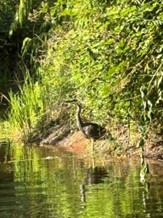
On July 3, 2025, we got off the ferry in Powell River, BC—a small working class town along the Sunshine Coast on Tla’amin territory with a stellar view of the ocean and Vancouver Island—and moved into our new home on 5 acres of forest and farm land. We don’t have a stream, but we do have 3 ponds, host to herons, ducks, giant bullfrogs, and snakes. And we spent spring break last week working on a chicken coop. Next up on our project list: raised beds for a big garden. Across the street from our home is the entrance to a trail system through the forest and Orrin is here not only with his mom and I, but also his dad and little brother, and his sister and her mom!
Abundance
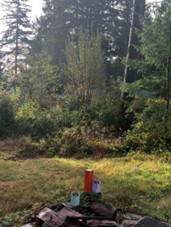
It is easy to be in right relationship with Life here because abundance is everywhere! Every day is a fresh discovery, a new gift. For breakfast, I walk across the meadow to feast on ripe blueberries warm from the sun. For a sunset treat, we bring our bowls to the far corner of the land to our prized raspberry patch, taking me back to my childhood in northern California. Erin uses our bounty to make homemade raspberry vodka, a fun science project that sits on our counter for about 8 weeks, and we put bags of them in the freezer, imagining taking them out during the depths of winter to remember our first summer in Powell River.
On hikes, we scarf on abundant huckleberries, salmonberries, and salal, even finding the occasional thimbleberry—an even more delicate and decadent version of raspberries. After Erin bemoans the poor quality of the walnuts available in the grocery store in town, Orrin discovers we have 2 walnut trees—though the small feisty squirrels here control the harvest and guard them fiercely. Two hazelnut trees bear long elegant blooms that look like fluffy caterpillars.
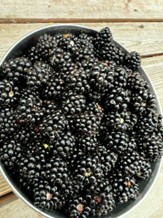
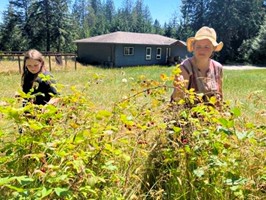
The blackberries are so abundant that it becomes a problem. They will entirely consume the land if not given boundaries and containment. But they resist containment, entwining themselves in trees and reattaching their reaching arms into the soil, so setting boundaries with them can be daunting. They certainly have their own consciousness. Even as I think about chopping them back, they creep towards me, painfully sticking to my back, wrapping around my ankles, stabbing me in the hands and face to try to stop me. At times it feels like Little Shop of Horrors and I feel afraid of their wrath. My partner buys me double thick work pants and a denim jacket to be a blackberry warrior. I contemplate adding a face shield when I have to get a tetanus shot after a particularly painful encounter. The blackberries become my role models for determination and persistence, reflecting the strong survival instinct I’ve recently come to see in myself as I have fled the U.S. and taken myself to safety, just as I once fled my mom and moved across the country.
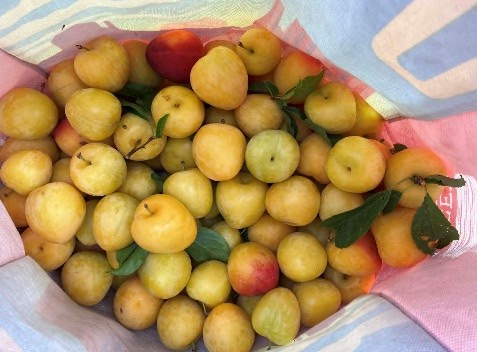
We miss the cherries entirely, as they ripen right when we arrive, exhausted and surrounded by boxes. The birds feast on them. We learn our lesson with the grapes, waiting one more day for them to fully ripen. When we awake the next morning, we find them all gone, devoured by bears, except for one small cluster. We set up a table along the road in front of our place with a scale, a box for cash, and a sign advertising yellow plums to try to manage the buckets and buckets of fruit that we frantically pick. A spindly bush along the wall of the garage suddenly sprouts the biggest, most gorgeous, lush looking peaches I’ve ever seen. Pears, apples, figs come and go while we are busy getting Orrin settled in school.
It is impossible to keep up. We have more than what we need—our true relationship to Life, not the toxic scarcity thinking we are trained to painfully believe. I try to mark on our calendar when things ripen so that we can be better prepared next year. The whole first year feels very Little House on the Prairie, learning what to expect from the seasons, how to take care of the land and be in right relationship with it, making rookie mistakes.
We are surrounded by the abundance of not only plant life here, but also wildlife. In the morning when we walk Orrin to the bus stop for school, we survey the latest piles of poop. Is it Bear or Elk or something else? Sitting on the back porch one fall morning sipping warm tea, we look up to see a juvenile black bear lumbering across the meadow, looking as startled to see us as we were to see the bear. Deer bed down overnight in the tall unruly grasses overgrown from years of neglect by the former owners. At night we must carry flashlights because of the omnipresent giant black slugs underfoot, reminding me of the bright yellow banana slugs from my days at UC Santa Cruz. 8 female ducks and a heron take residence on our ponds, immediately flying off at any sign of threat. A bald eagle sits in the tree above the meadow.
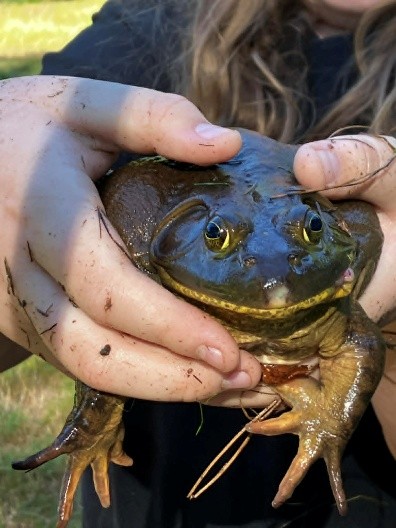
Our first day here, Orrin puts on his swimsuit and immediately wades into the murky pond, which is surprisingly deep. He comes back with a GIANT bullfrog that he names Jeremiah. Other friends quickly followed: Pickles and Limey, distinguishable by their bumpy texture and green complexion. The first time we see a heron in the pond Orrin is ashen, fearful for Jeremiah’s fate. After proudly proclaiming himself for weeks with a demanding croak that sounds more like an angry cow, Jeremiah goes silent for a few days and Orrin is certain that he is a goner. We all breathe a sigh of relief when, once again, we hear his booming proclamation echo around the land.
At the base of the grandmother cedar tree between the house and the barn is a garter snake den and Orrin becomes an expert snake catcher. He holds them while we play board games on the outdoor table where we have all our meals, our only furniture for weeks. He carries them in the pouch of his plush poncho that he wears to keep off the morning chill. Anytime we have a visitor to the land, Orrin plucks a snake from the grass with laser sharp precision to give guests a close up view. His favorite is a tiny baby snake he names Strudel.
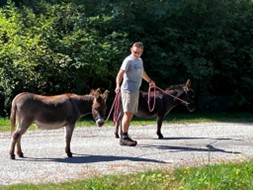
The soundtrack for our new life is a combination of wild noises. The beating of Raven’s wings as they glide by overhead with a sassy croak. The screaming of the 2 donkeys who live down the road, Nemo and Forest, which sounds distinctly like they are being murdered. The rooster we nicknamed Midnight because he announces the dawn at all hours of the day and night. The hummingbirds that zing by with a sharp trill. Our neighbor’s dogs whose frenetic barking in the dark night announces the presence of some sort of wildlife.
Connecting to the Earth
All I want to do is be out on the land. I enjoy being physical in my body, endlessly carrying boxes back and forth to the barn. A lifelong late night person, I find myself rising early to get out on the land to battle blackberries. The hours pass quickly as I can’t resist the temptation of tackling just one more square patch. I feel like I could spend the rest of my life in this pursuit, as by the time I finally finish cutting back the last corner of the land, it would be time to start at the beginning again.
Most of my time is spent getting settled in my new life, unpacking, getting accustomed to living with a kid for the first time, learning how to steward 5 acres when I’ve never even had a garden before! I do have a couple of work gigs, social justice trainings for mostly U.S. based queer choruses. Doing educational and transformative work has been my main passion for my entire adult life, so I am surprised to find myself only impatient at having to sit down in front of my computer. I crave being outside, doing something that feels “real.” I never would have characterized my former life as not real, but I realize how much of my life has been spent sitting and thinking, buried in a book or a screen, and I feel a newfound sadness at what I have missed as a result.
I also feel impatient to be solely located, physically and emotionally. Previously when I’ve moved somewhere, I spent so much time going back to my old life to maintain connections. When I got my job at University of Missouri, I drove 8 hours each way back and forth to Minneapolis every week for choir practice for an entire year! While previously I viewed this commitment as a strength, I begin to see some of the costs of my habit of being multiply located.
Since my relationship to the U.S. has always felt like a toxic marriage, I notice my desire to have a proper break up, to let that part of my life be done so that I can move on fully into my new life. After spending my entire adult life trying to create change in the U.S., with a culture that has stubbornly chosen to resist needed change (and even increasingly doubled down in the opposite direction), I reached my breaking point. Now, as in any toxic marriage, I stop caring whether they get therapy and change or not. I choose to control the only thing I can control: its impact on me. Much to my surprise, I decide to skip the 10th anniversary concert of the trans choir that I founded and left behind in Colorado.
Consolidating
My new life needs my full attention. Everything I’m doing—parenting, home ownership, land stewardship—is entirely new to me, not things I’ve even thought about or prepared for because they weren’t what I ever expected to choose for myself. At this stage in my life, when many people feel like they’ve done and seen it all, what a gift to have a life that is totally new! What incredible personal growth and soul expansion!
In contemplating my current life, I am reminded of the Joseph Campbell quote: “We must be willing to let go of the life we planned so as to have the life that is waiting for us.” This was not the life I’d planned for myself—this is the life of my parents in many ways, the life that I rejected—but the more I settle into it, surprisingly, the happier I become. It is funny to again be doing life stages out of order. I did adolescence in my 40’s when I went on testosterone, and now I’m doing marriage, family, and home—what most people do in their 30’s—during my retirement years. Maybe it’s developmental trauma, or maybe it’s just how I do life: out of order. It’s never too late, I guess.
It always felt like having kids and a home would monopolize my time and attention, severely limiting my ability to serve the world. What a small focus and limited impact, I thought. It seemed like a trap most middle-class people fell for, and part of the reason our collective life was failing—no one invested in community because they were busy mowing their lawns and driving their kids to soccer practice.
But at this phase in my life, deeply investing in a couple people and a plot of land feels just right. I spent my adult life devoted to teaching/social justice work, burning myself out having a big impact on the world around me. This phase of life—initiated by the passing of my mom, allowing me to finally relax and have some space to exist—is about my own happiness.
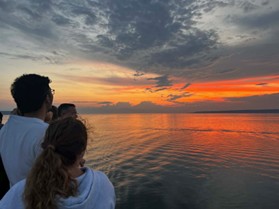
So much of my peace and happiness in my previous life came from my time in the natural world—shamanic retreats, music festivals, hot springs weekends with my partners, sunsets at the ocean, abundant camping and hiking. It was the reason I’d moved to Colorado after all, and the 100 miles I hiked with my former partner, Amanda, in Minnesota state parks defined our years in Minneapolis just as working and family vacationing in Yosemite National Park defined my early years in California.
My previous relationship to the natural world had an overlay of anonymity to it, however. I had a strong relationship to the natural world, but it was like my relationship with the city. It was someplace that I went, outside of my everyday life, and, even though I had favorite places, I was a stranger there and my interactions were largely anonymous with beings I’d likely never encounter again. In a way it was more like having a relationship with a concept.
But here, I get to build an ongoing relationship with a specific piece of land, diverse enough to offer endless fascination, but contained enough to feel deep and meaningful, rooted in my everyday life. Here I get to cultivate ongoing connections with specific trees, specific frogs, specific ducks and notice things through our everyday relationship that I would miss as a visitor. Not unlike the familiarity and trust and intimacy that Erin and Orrin and I are cultivating by living together for the first time. I never felt like anything was lacking previously, but now that I’m experiencing it, I can see how much I was missing—in both the natural and human realms.
And now I get to share that connection with others as well. The land has revealed to me its desire to be known and to be appreciated so part of my role as steward is to fulfill this conscious desire of the land—to bring people here and create healing experiences for them. Erin and I are planning to open a retreat center at our new home, so our projects here have centered around imagining people doing dyads in the barn, walking contemplation around the ponds, a labyrinth in the meadow, journal writing at the picnic table, camping under the stars in the Magical Forest. How can we best facilitate this healing and transformative experience of the sacred? I feel so moved to realize that this land may become sacred and important in the lives and stories of others in ways that Crow’s Nest (my shamanic community in Dowagiac, Michigan), Sunrise Ranch (where the Arise Music Festival was held in Colorado), Valley View (our favorite nudist hot springs), and “the land” at the Michigan Womyn’s Music Festival were for my healing and happiness.
Rural Life
The pace of life here is also a good match for my less ambitious life phase and nervous system reset. There are just 6 stoplights in all of Powell River! In town, it is a 5 minute drive to any destination. The highway to town through the forest along the ocean is only 2 lanes, never exceeding 50mph. People aren’t in a hurry here, and they aren’t angry, traumatized, or dysregulated. What is most difficult to explain to my friends in the U.S. is that there is no end of the world feeling here. My nervous system takes a deep sigh of relief and starts to settle.
I discover the gift of limited options. People participate enthusiastically in community events here, as there aren’t as many of them, making each one special and a source of community engagement. I’ve only lived in cities and college towns, where there are 50 options for every moment, leading to overwhelm, anonymity, and less actual participation because events are more taken for granted. When Erin and Orrin and I search for a couch for our new living room, we don’t have to compare styles and prices at 10 stores because there’s only 2. The simplicity is a gift. I don’t need so many choices. More choices than I need actually feels burdensome and depleting.
Previously I never wanted to be tied down to one place for the rest of my life, so I’m surprised to discover the feelings of safety I experience from owning our own home. Nobody is going to police me or confront me or cast me out. After feeling as a trans person like the nuclear reactor nobody wanted in their neighborhood, I finally have a place in the world and it gives me a sense of security and stability. And it feels fun to build something together with Erin and Orrin.
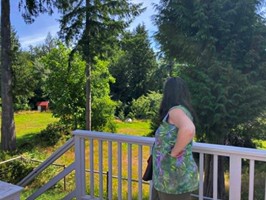
I’m also surprised by the feelings of safety that emerge in community. People here are intact and relaxed and open and available in a way I’ve never experienced. The lack of safety people in the U.S. are experiencing currently is intense, but I realize, being here, the ways I never felt safe in the U.S.—and not just due to the obvious reasons of being trans and queer. The competitiveness and self absorption and left brain orientation of U.S. culture (valuing goals and success and achievement, assessment, control, and certainty) creates a lack of safety for everyone. People in the U.S. are so rarely content where they are—they always seem to be chasing something better, striving to be someone or someplace else. And as we step out of responsiveness in the moment into the need to act from our own disconnected sense of what should happen next [usually generated from our anxiety], we are no longer truly present with one another. Consider the loneliness we often feel when we share our feelings with another and, in their anxiety about our suffering, they jump into their left hemisphere and try to offer a fix it solution, abandoning us in the process and offering an invitation for us to disconnect from ourselves and join them in that disembodied left orientation.
But people here feel present and happy, appreciative of simple pleasures. Probably the defining feature of all the events we’ve attended in Powell River is the notable intergenerational participation. Outdoor concerts are held next to playgrounds, so parents and kids can parallel play. We attend a sold out Family Dance at the Polish Hall, an evening of essentially square dancing with small children and grandparents side by side, where teen boys hold hands dancing together unself-consciously. Even the public lecture by a Truth and Reconciliation commissioner is filled with children. And there’s a sweetness to the vibe that is surprisingly touching to me, not being a kid person myself. It’s something I noticed in our very first visit here last year—how present parents and kids are with one another here, the absence of stress and dysregulation and distractions like technology and devices, the presence of spontaneous joy and relaxation. There’s an intactness and innocence here—in individuals and in the community—that I haven’t experienced in the U.S. in decades. It feels more like my childhood memories of the 70s than the contemporary dystopian nightmare my students in the U.S. find themselves in.
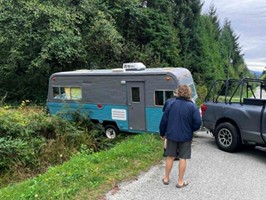
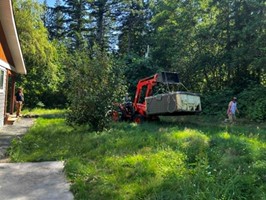
In our first weeks, neighbors stop by endlessly. One does an oil change for us on our ride-on mower. Another teaches Orrin how to drive it. Another brings his forklift to help us move our hot tub. Doug comes with a tractor to clear a spot for Jade’s trailer. He also offers to help us build the chicken coop. Neil rescues us when Jade’s trailer accidentally ends up in the ditch. Kyle and Kaeli help us move a couple trees and teach us how to prune our fruit trees. Their generosity is extremely moving to us and we are humbled by their practical expertise that we clearly don’t have.
We learn different social expectations. Ask someone here for basic information and you are likely to get a 20 minute story lol. When we first move in, a friend from Seattle comes to visit us and she becomes overwhelmed by the neighbors, who feel intrusive according to her expectations. I recall my American socialization, oriented towards privacy and self sufficiency—and think of all the people I know who express how lonely they feel in the U.S. Here people just stop by rather than texting to schedule a coffee date 2 weeks from now.
Overall what I feel here is care. Living in a country that cares for its citizens. Living in a community where most of the people went to the same high school and seem to genuinely enjoy one another. Living in an area where neighbors look out for one another and where sharing of expertise and machinery is unceremoniously commonplace.
And this care is evident in people’s relationship with the world around them. So much of the disintegration of the commons in the U.S. is because nobody wants to take responsibility unless it directly benefits them. Here everything is so clean! You can feel the care and responsibility in people’s relationship to public spaces. There’s no garbage blowing in parking lots or left on the ground after the local music festival, the beaches are totally pristine and the water is so crystal clear you can see straight to the bottom while ocean kayaking. There’s not even any roadkill along the side of the highway.
The results of all this care and lowered human footprint is remarkable. Every time I go to the ocean, within 5 minutes (literally) I have a close up major wildlife encounter: seals most commonly, but also orcas, jellyfish, herons, sea lions, otters, starfish. Ferries between Powell River and Vancouver Island are basically whale watching cruises. When the herring were spawning at the beginning of March, we went for a walk along the ocean and—in a quick scan along the beach—saw more bald eagles than all the bald eagles I’ve ever seen over my lifetime! In Colorado, major wildlife encounters might occur maybe a couple times a year, but here they are my weekly experience.
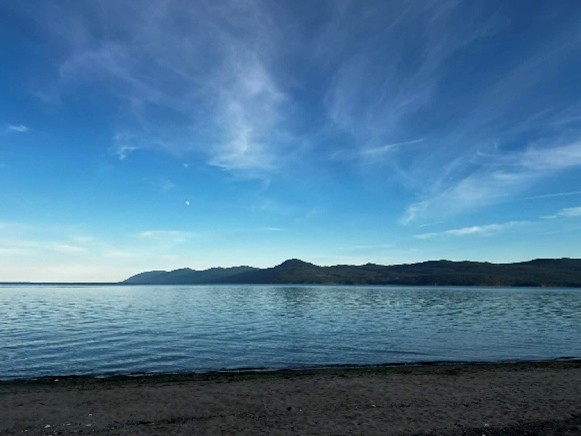
I have named these experiences remarkable, but really what they are is evidence of right relationship: the abundance reflective of right relationship with the natural world, the safety reflective of right relationship in the human community, the consolidation evidence of right relationship with self.


Enjoyed reading your account of moving to the the qathet area and small town vibe.
Glad you, Erin, and Orrin chose to move here and discover some peace and safety.
LikeLike
Aw thanks Lisa. It was a great decision!
LikeLike